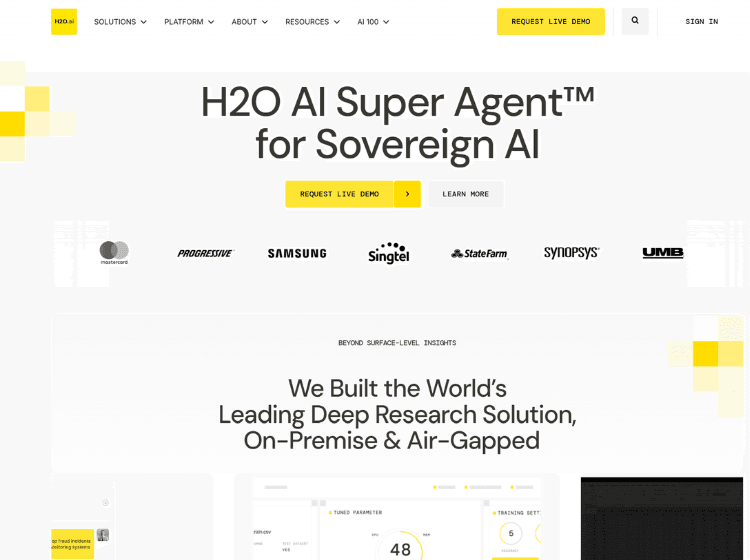
H2O AI Super Agent™ for Sovereign AI
What is H2O AI: Overview
H2O AI is an enterprise-focused artificial intelligence platform designed to help organizations build, deploy, monitor, and scale machine learning and generative AI solutions. The platform includes open-source machine learning tools, automated machine learning capabilities, AI application development frameworks, AI agents, model management tools, and enterprise-grade generative AI products. Users can develop predictive models using H2O-3 and AutoML, create applications with H2O Wave, automate feature engineering with Driverless AI, and build AI assistants through enterprise generative AI solutions. The platform supports deployment across cloud, on-premises, hybrid, and air-gapped environments, making it suitable for organizations with strict security and compliance requirements. H2O AI also integrates with existing data infrastructure and supports popular development environments such as Python, R, Spark, and Kubernetes. Its ecosystem is widely used for analytics, forecasting, fraud detection, customer service automation, document intelligence, and operational decision-making.
Key Features of H2O AI
- Automated Machine Learning (AutoML) for model training and optimization.
- Open-source machine learning platform with support for Python, R, Spark, and Hadoop.
- Enterprise generative AI and AI agent development capabilities.
- Model deployment, monitoring, governance, and MLOps tools.
- Flexible deployment across cloud, hybrid, on-premises, and air-gapped environments.
How to Use H2O AI: Step-by-Step
Here are the simple steps to start ussing the H2O.ai platform.
Step 1: Access the Platform – Visit the official H2O AI website and explore the available products, including H2O-3, Driverless AI, AI Cloud, and enterprise AI solutions.
Step 2: Choose a Deployment Option – Select a managed cloud deployment, hybrid deployment, or self-hosted infrastructure based on organizational requirements.
Step 3: Import Data – Connect data from supported sources such as cloud storage, Hadoop, Spark, Azure Data Lake, or other enterprise systems.
Step 4: Build Models – Use AutoML, machine learning algorithms, or no-code tools to train predictive models and evaluate performance.
Step 5: Deploy and Monitor – Deploy models into production environments and monitor performance through H2O MLOps and AI Cloud services.
Step 6: Scale AI Applications – Create AI-powered applications, assistants, or workflows and integrate them into business operations.
Use Cases of H2O AI
- Fraud detection and risk analysis.
- Predictive analytics and forecasting.
- Customer service and AI-powered assistants.
- Document processing and knowledge retrieval.
- Model development, deployment, and monitoring for enterprise AI projects.
Target Audience
- Data Scientists
- Machine Learning Engineers
- AI Researchers
- Business Analysts
- Enterprise IT Teams
- Financial Services Organizations
- Government Agencies
- Telecommunications Companies
- Healthcare Organizations
- Large Enterprises Managing AI Workloads
H2O AI Pricing
1. H2O-3 Open Source – Free (Apache 2.0 License)
2. H2O AutoML (Open Source) – Free
3. H2O Driverless AI – Not publicly disclosed
4. H2O AI Cloud – Not publicly disclosed
5. Enterprise h2oGPTe & Enterprise AI Products – Not publicly disclosed